Citizen ManagementFear · Happiness · Hunger · Loyalty
In Pax Autocratica, citizens are not background props — they are simulated individuals who feel gratitude, feel fear, swear loyalty, and quietly brew rebellion. How you rule them decides whether the colony becomes an efficient machine of the State or a volcano about to erupt.
The Four Core Stats
Per official materials and gameplay footage, each citizen's condition is shaped by the following dimensions:
| Stat | Role |
|---|---|
| Fear | The bedrock of iron-fisted rule — fear suppresses dissent, but letting it pile up too deep plants the seeds of eruption |
| Happiness | The core of the prosperity path — a comfortable life keeps citizens grateful |
| Hunger | The survival baseline — a colony that cannot feed itself has no loyalty to speak of |
| Loyalty | The ultimate metric of rule — loyal citizens work diligently; the disaffected brew rebellion |
The official description of citizen states is a four-point spectrum: "grateful, afraid, loyal, quietly rebellious" — discontent keeps accumulating "until dissent becomes revolt" (see Rebellion & Suppression). Hands-on press also observed productivity as a derived stat that directly affects colony efficiency.
Jobs & Assignment
Citizens can be assigned to posts across the colony. The officially confirmed base job types include:
- Mining (Mine) — extract mineral resources
- Gathering (Gather) — collect raw materials
- Hauling (Haul) — move supplies between facilities
- Research — advance the tech tree (see Colony Building & Research)
- Manufacturing (Manufacture) — produce weapons, armor, food and supplies
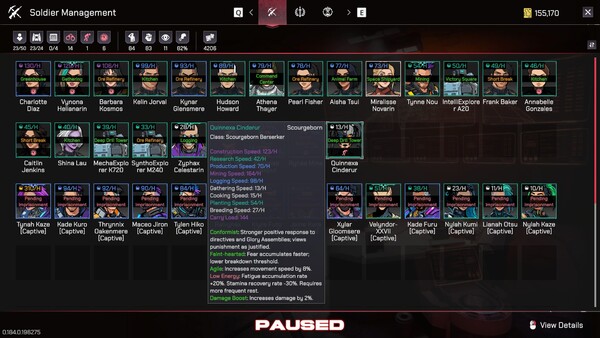
The official "soldier management" screen shows that personnel have granular speed stats: Construction, Research, Production, Hauling, Gathering, Shooting, Breaking and Observation — putting the right person in the right post is the heart of management. Soldiers also have levels (gameplay shows an X/50 level marker) and status tags (such as [Captive] and [Sick]).
The Trait System
Personnel carry Traits that shape their behavior. The following trait examples appeared in the official gameplay UI:
| Trait | Effect (compiled from UI descriptions) |
|---|---|
| Conformist | Responds more positively to orders and accepts punishment as justified; but fatigue builds faster and the breakdown threshold is lower |
| Agile | Movement speed +8% |
| Low Energy | Fatigue buildup +20%, stamina recovery -30%; needs more frequent rest |
| Damage Boost | Damage dealt +2% |
Traits mean no two citizens are exactly alike: the press likewise advise "running your soldiers like an organization, not interchangeable screws" — assign posts according to stats and traits, and keep an eye on their food, rest and condition.
Two Paths of Rule
Officials explicitly offer two viable philosophies of rule:
- The fear path — propaganda, surveillance, punishment, intimidation tactics, curfews, harsh labor conditions. It suppresses dissent fast, but as hands-on press put it: "be too cruel and you'll get unrest and rebellion."
- The prosperity path — better food, better housing, paternalistic appeasement. "But be too generous and supplies run scarce."
The State has also prepared more... direct tools: the Whip is a real game mechanic — official screenshots show an interaction prompt to "Whip" a citizen. Gameplay screenshots also show a directive to complete the "High-Pressure Labor" policy research at Victory Square, proving that policy research directly unlocks new tools of governance.
Multiverse has never published exact stat values or rebellion thresholds; claims circulating online such as "loyalty below 30 guarantees a revolt" are fabrications. Only one principle is verified: fear and prosperity must be balanced dynamically — use surveillance and policies to spot the first signs of discontent, and deal with dissent before it accumulates into rebellion.
Currency & Daily Wage
The colony economy runs on CredChips, and the top-left of the HUD shows a live Daily Wage counter alongside the in-game clock (T.C. calendar + date). Citizen output, expedition loot and merchant trade together form your fiscal loop — see Colony Building & Research for details.